A Living Hope for Alien Times (1 Peter 1 & 2)
Part II in a four-part journey through the Epistles of Peter: In a world that often feels unfamiliar and costly to faith, Peter’s first letter reminds believers who they are, what they are called to, and how they are to live. Rooted in 1 Peter 1–2, this teaching explores our identity as God’s chosen people, our call to holy distinctiveness, and our witness as faithful exiles—anchored in a living hope that suffering cannot destroy.

See also: Part I - A Letter from the Rock: An Introduction to the Epistles of Peter
Introduction: Peter’s Question — And Ours
There is a question many believers ask quietly, often after years of following Jesus.
It is rarely asked in moments of triumph, but in moments of cost.
Not when faith feels exhilarating, but when it feels demanding—when obedience begins to feel expensive.
Peter once asked it out loud.
After watching a rich young ruler walk away unwilling to surrender everything, Peter turned to Jesus and said:
“We have left everything to follow You. What then will there be for us?” (Matthew 19:27)
It is an honest question—part faith, part fear.
And it was not Peter’s alone. It reflects a deeply human desire for assurance: that our sacrifices matter, and that our hope rests on something firm.
Roughly thirty years later, Peter answers that question—not with theory, but with lived wisdom shaped by failure, restoration, and the grace of God. Writing to believers scattered across Asia Minor, whom he deliberately calls exiles and foreigners, Peter reframes the Christian life entirely. His answer is not centred on comfort, success, or social acceptance, but on identity, holiness, and faithful witness, grounded in what he calls a living hope (1 Peter 1:3).
Part I: Our Identity — Born Into a Living Hope
(1 Peter 1:1–12)
Peter does not begin with instructions.
He begins with assurance.
Before believers are told how to live, they are reminded who they are—because conduct flows from identity, and endurance flows from hope.
A NEW IDENTITY: CHOSEN, HOLY, AND SECURED
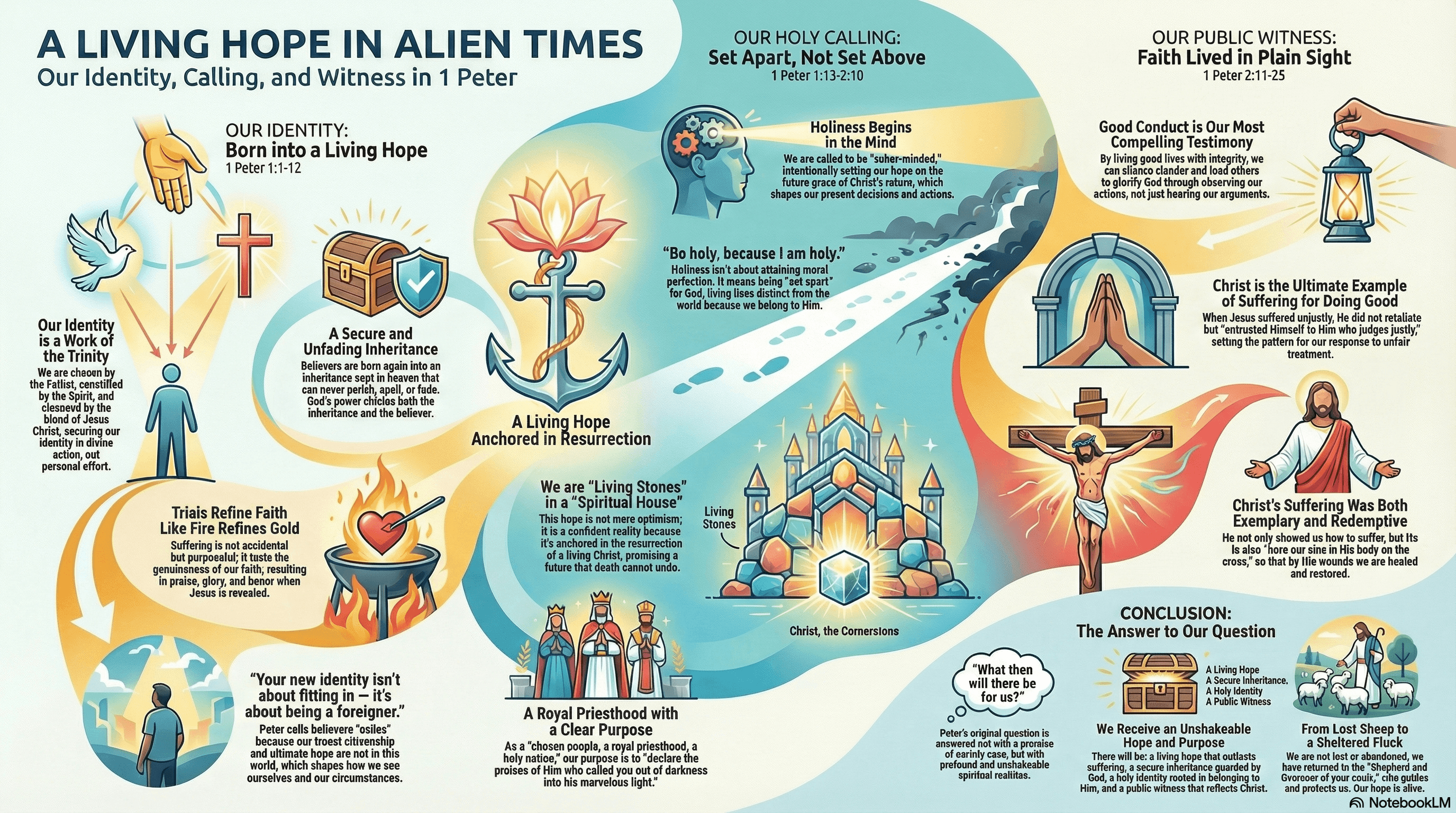
Believers are chosen according to the foreknowledge of God the Father, sanctified by the Spirit, and sprinkled with the blood of Jesus Christ (1 Peter 1:2). Their identity is a work of the Triune God, secured by divine action—not personal effort.
Peter declares that they have been:
"Born again to a living hope through the resurrection of Jesus Christ from the dead” (1 Peter 1:3)
This hope is living because it is anchored in a living Christ. It is not optimism or positive thinking, but confidence grounded in the historical reality of Jesus’ resurrection. Because He lives, believers share in a future that death cannot undo.
This new birth also brings an inheritance that “can never perish, spoil or fade—kept in heaven” (1 Peter 1:4). Not only is this inheritance secure, believers themselves are “shielded by God’s power through faith” (1 Peter 1:5). God guards both the future He promises and the people who will receive it.
Key Anchor (Identity): Your new identity isn’t about fitting in — it’s about being a foreigner.
Peter repeatedly calls believers exiles because their truest citizenship no longer lies where they reside (1 Peter 1:1; 2:11).
THE PURPOSE OF OUR TRIALS
Peter addresses suffering not as an interruption to faith, but as part of its formation.
“Though now for a little while you may have had to suffer grief in all kinds of trials” (1 Peter 1:6)
At first glance, suffering may seem contradictory to hope. Yet Peter frames trials not as a threat to God’s goodness, but as an essential element of the Christian journey. Our suffering is not accidental; it is purposeful.
Like gold refined by fire, faith tested under pressure reveals its genuineness (1 Peter 1:7). What emerges from such refining is not loss, but depth—faith that will one day result in “praise, glory and honour when Jesus Christ is revealed.”
This leads to one of the great paradoxes of the Christian life: the ability to rejoice even while grieving. Peter does not deny sorrow. He acknowledges that there are seasons when grief is necessary—appointed by God for reasons we may not immediately understand. Even Jesus Himself grieved in the Garden of Gethsemane.
The joy Peter speaks of, therefore, is not the absence of pain. It is a deliberate posture—rooted in the security of our future in Christ and the certainty of “the salvation of your souls” (1 Peter 1:9). A faith that has been tested and refined will not be wasted; it will one day stand to God’s glory.
Our identity in Christ is thus profound, secure, and glorious—and it is this identity that gives us both the motivation and the strength to walk faithfully into our holy calling.
Part II: Our Holy Calling — Set Apart, Not Set Above
(1 Peter 1:13–2:10)
With identity established, Peter turns to response:
“Therefore, prepare your minds for action; be sober-minded; set your hope fully on the grace to be brought to you when Jesus Christ is revealed.”
(1 Peter 1:13)
Christian living does not begin with outward behaviour, but with inward orientation. Because we have been born again into a living hope, we are called to live differently. Our identity shapes our actions; who we are in Christ determines how we walk in the world.
THE BATTLE FOR THE MIND AND THE CALL TO HOLINESS
Peter’s first concern is the mind. Holiness begins with renewed and intentional thinking. To be sober-minded is to be clear-headed, alert, and disciplined in what we allow to shape our desires and hopes. This is not passive—it is a daily battle, because new identity requires new patterns of thought that do not come naturally.
We are called to set our hope fully on the grace that will be revealed when Jesus returns, allowing that future certainty to shape present decisions, attitudes, and conduct.
At the heart of this calling is Peter’s unmistakable command:
“Be holy in all you do; for it is written: ‘Be holy, because I am holy.’” (1 Peter 1:15–16)
Holiness, however, is often misunderstood. Drawing from Leviticus, Peter defines holiness not as unattainable moral perfection, but as being set apart. God called Israel to live differently from the surrounding nations—not to earn His favour, but because they belonged to Him. In the same way, believers today are called to lives that are distinct, shaped by allegiance to God rather than conformity to the world.
Peter also calls believers to live in reverent fear—not a fear of punishment, but a deep awareness that our loving Father is also an impartial Judge who disciplines His children for their good, so that they may share in His holiness.
Key Anchor (Holiness): Holiness isn’t unattainable perfection — it is being set apart.
THE SPIRITUAL HOUSE OF GOD
Peter then shifts from individual holiness to communal formation. He describes the people of God not as an institution, but as a living, growing structure—a spiritual house built of living stones upon Christ Himself.
Before this building can take shape, Peter gives a necessary instruction: believers are to rid themselves of attitudes that fracture community—malice, deceit, hypocrisy, envy, and slander (1 Peter 2:1). Having cleared the ground, they are then called to crave the Word of God like newborns crave milk—deeply, instinctively, and for growth (1 Peter 2:2).
Having tasted that the Lord is good, believers are drawn toward Christ, whom Peter describes as the Living Stone—rejected by people, yet chosen and precious to God (1 Peter 2:4). In ancient construction, the cornerstone was the most critical stone, carefully chosen to align and stabilise the entire structure.
Believers, too, are described as:
“Living stones… being built into a spiritual house.” (1 Peter 2:5)
We are not lifeless bricks, but living participants. Each believer is intentionally placed, contributing strength, stability, and beauty to the whole. A missing stone in a pile goes unnoticed; a missing stone in a building weakens the structure.
Peter concludes this section with a cascade of identity statements:
“You are a chosen people, a royal priesthood, a holy nation, God’s special possession…” (1 Peter 2:9)
Under the Old Covenant, royalty and priesthood were separate roles. In Christ, they are united. Believers serve the King and belong to His household, granted both dignity and access.
This identity carries purpose:
“… that you may declare the praises of Him who called you out of darkness into His marvellous light.”
As a royal priesthood, believers now offer spiritual sacrifices—not animals on an altar, but lives shaped by devotion and love: offering ourselves, praise, good works, love for others, prayer, and faithful witness.
Key Anchor (Purpose): Your purpose isn’t merely individual — you are a living stone in a spiritual house.
Each of us is carefully chosen and placed by the Master Builder, bringing stability not only to our own lives, but to the community of faith as a whole.
Part III: Our Public Witness — Faith Lived in Plain Sight
(1 Peter 2:11–25)
Having established who believers are and what they are called to be, Peter turns to how they live before a watching world.
He addresses them once more as foreigners and exiles—people whose deepest loyalties and values do not align with the societies they inhabit (1 Peter 2:11). Yet his guidance is not a call to retreat or withdrawal. It is a call to faithful presence: to live in the world in a way that quietly but unmistakably points beyond it.
A LIFE OF HONOR TO SILENCE SLANDER
Peter begins with an inward battle that has outward consequences. He urges believers to abstain from sinful desires that “wage war against your soul” (1 Peter 2:11). These desires are not harmless impulses; they distort our loves and dull our sense of God’s wonder, making worldly pleasures appear more compelling than the light we have found in Christ.
The antidote Peter offers is not argument, but conduct:
"Live such good lives among the pagans that, though they accuse you of doing wrong, they may see your good deeds and glorify God" (1 Peter 2:12).
In a climate of suspicion or misunderstanding, the most compelling testimony is a life marked by integrity, consistency, and quiet goodness. When accusations arise, they are not answered with defensiveness, but with lives that speak for themselves—lives that eventually direct attention not to the believer, but to God.
SUBMISSION AS FREEDOM AND STRENGTH
Peter then addresses an issue that feels countercultural in every age:
"Submit yourselves for the Lord’s sake to every human authority" (1 Peter 2:13).
This call to submission is not an endorsement of injustice, nor a denial of wrongdoing. Rather, it is rooted in trust—trust that God remains sovereign even when human authority is flawed. Peter makes clear that submission is done “for the Lord’s sake”, not because earthly powers are ultimate, but because God is.
Crucially, this submission is not weakness. It is a freely chosen act of obedience that flows from allegiance to a higher kingdom. Peter holds the tension clearly: “Fear God, honour the emperor.” Ultimate loyalty belongs to God alone.
To suffer for doing wrong is no credit to us. However, by doing good within imperfect systems, believers silence ignorant talk and bear witness to a different kind of freedom—the freedom to serve God without fear, and to entrust outcomes to Him.
Key Anchor (Witness): Submission isn’t weakness — it is entrusting yourself to the ultimate Judge.
Submission becomes an act of strength when it flows from trust in God’s justice rather than the need to control outcomes.
THE ULTIMATE EXAMPLE: SUFFERING FOR DOING GOOD
Peter grounds this difficult calling in the life of Jesus Himself:
"To this you were called, because Christ suffered for you, leaving you an example, that you should follow in his steps" (1 Peter 2:21).
Jesus’ response to injustice sets the pattern for Christian witness. Though completely innocent, He did not retaliate. When insulted, He did not threaten. Instead:
“He entrusted Himself to Him who judges justly.” (1 Peter 2:23)
This entrusting was not passive resignation; it was active trust in the Father’s justice and timing. And Peter is careful to remind us that Christ’s suffering was not merely exemplary—it was redemptive:
“He Himself bore our sins in His body on the cross… by His wounds you have been healed.” (1 Peter 2:24)
Christ suffered unjustly so that the unjust might be restored. His wounds became the means of our healing. And it is from this place—secured by grace, not self-righteousness—that believers are called to endure suffering for doing good.
Conclusion: What Then Will There Be for Us?
Peter once asked, “What will there be for us?”
Years later, his answer is clear —and quietly profound.
There will be:
- A living hope, not extinguished by suffering
- A secure inheritance, guarded by God Himself
- A holy identity, rooted in belonging
- And a public witness, shaped by Christlikeness
The Christian life, Peter shows us, is not a promise of ease or exemption from hardship. It is a promise of meaning—of being anchored in something unshakeable when everything else feels uncertain.
In a world where many feel displaced and weary, Peter reminds us:
We are not lost.
We are shepherded.
“You were like sheep going astray, but now you have returned to the Shepherd and Overseer of your souls.” (1 Peter 2:25)
And our hope is very much alive.
----
To help you engage with this teaching in the way that best suits you, the above content is available in three formats:
- Presentation slides: PDF (click link)
- Visual Summary
- Video
A Living Hope
Continue Reading
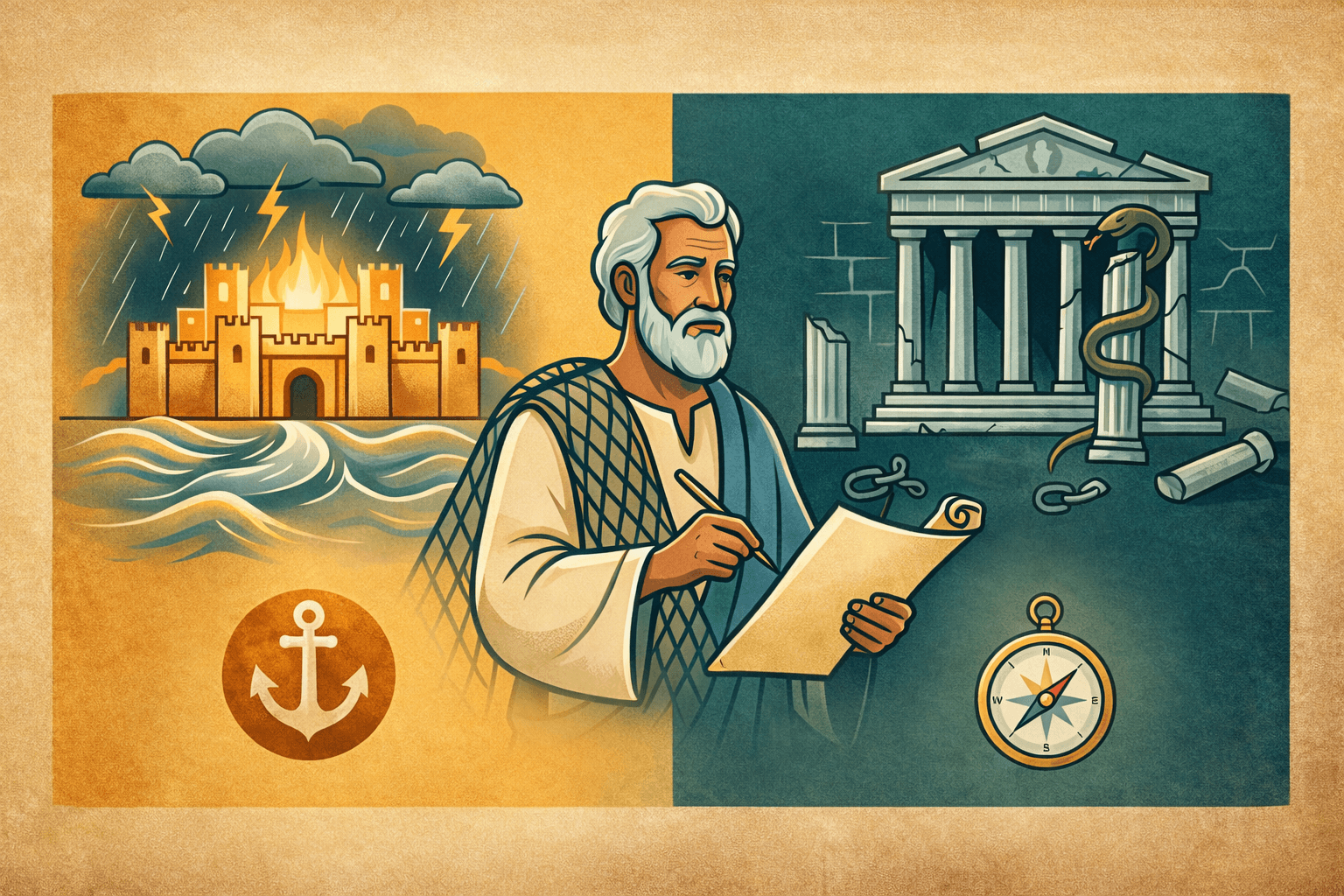
A Letter from the Rock: An Introduction to the Epistles of Peter
For believers walking through loss, opposition, discouragement, or uncertainty, Peter’s letters speak with a steady and compassionate voice of hope. He reminds us of our true identity as God’s own and anchors us in the living hope secured in Christ. This four-part series begins with an introduction, opening a gentle pathway into the themes and truths of 1 and 2 Peter.
For believers walking through loss, opposition, discouragement, or uncertainty, Peter’s letters speak with a steady and compassionate voice of hope. He reminds us of our true identity as God’s own and anchors us in the living hope secured in Christ. This four-part series begins with an introduction, opening a gentle pathway into the themes and truths of 1 and 2 Peter.
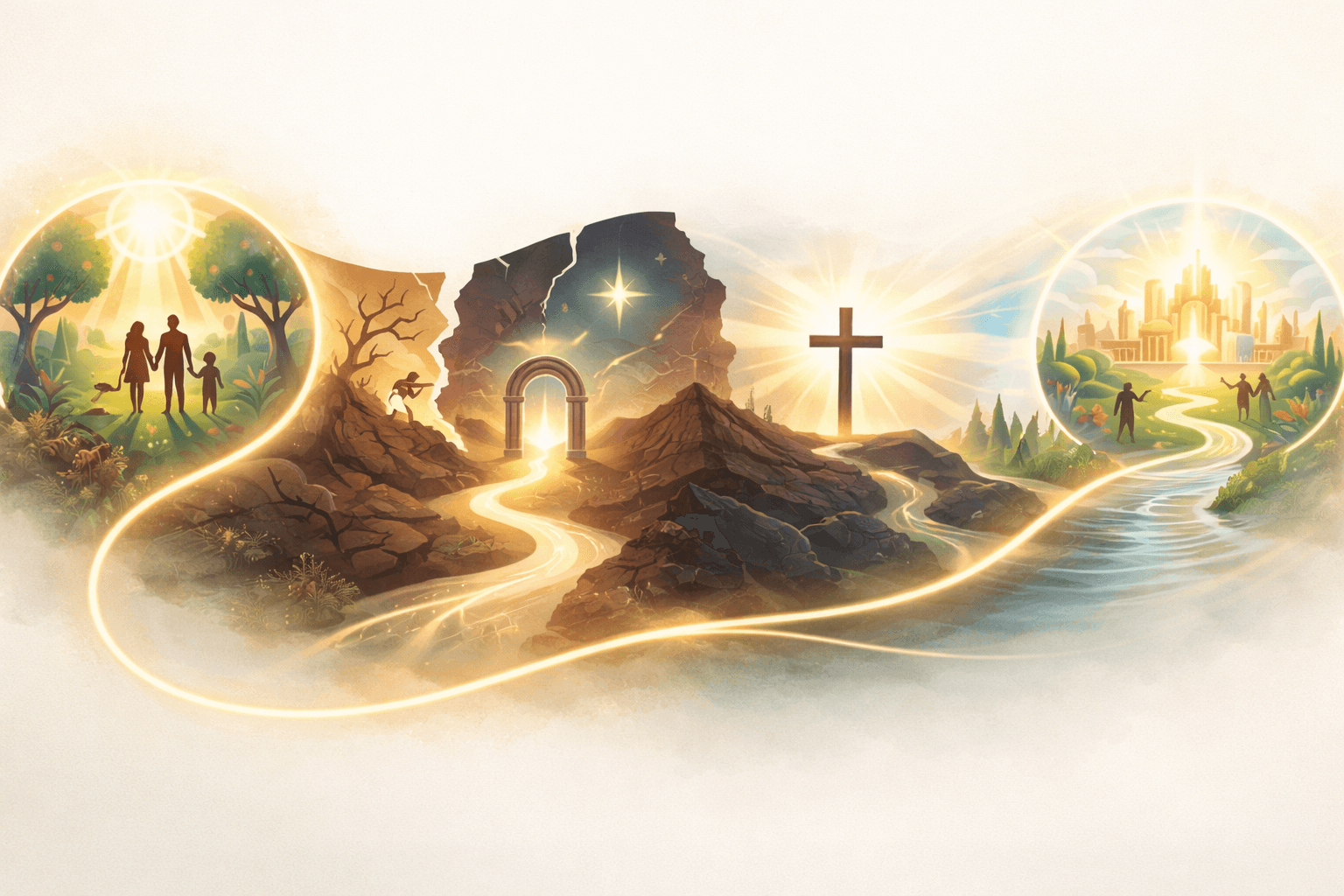
The Unbroken Thread: The Bible as One Unified Story
The Bible is often read in fragments—but it was written as one story. Across 66 books and more than 1,500 years, Scripture unfolds a single narrative of creation, brokenness, redemption, and hope. This teaching helps you see the Bible not as isolated passages, but as one coherent story that reveals God’s purpose for the world—and for us.
The Bible is often read in fragments—but it was written as one story. Across 66 books and more than 1,500 years, Scripture unfolds a single narrative of creation, brokenness, redemption, and hope. This teaching helps you see the Bible not as isolated passages, but as one coherent story that reveals God’s purpose for the world—and for us.

Living Out Our Calling in a Hostile World (1 Peter 3–5)
In Part III of our four-part journey through the Epistles of Peter, we explore how believers can respond to opposition with courage, love, and humility — turning suffering into a compelling testimony of hope in Christ.
In Part III of our four-part journey through the Epistles of Peter, we explore how believers can respond to opposition with courage, love, and humility — turning suffering into a compelling testimony of hope in Christ.